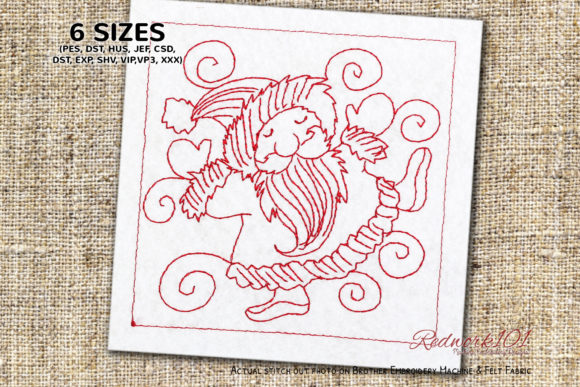
Happy Santa Claus Dancing Redwork: A Designer's Take
The First Glance Says a Lot
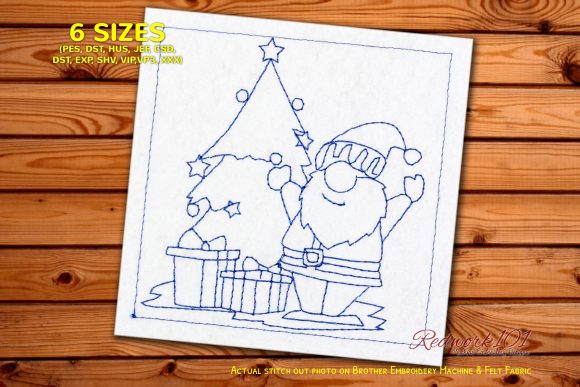
When I opened the Happy Santa Claus Dancing Redwork file, the first thing that struck me was the movement. This is not one of those stiff, standing-there-waving Santa designs you see everywhere. The figure has a genuine bounce to it, a kind of jolly mid-step pose that reads as cheerful without tipping into cartoonish. For a machine embroidery design meant to land on Christmas goods, that sense of motion matters. It makes the finished piece feel alive.
The redwork approach here is smart. By sticking to a single-color linework tradition, the design avoids the heavy satin stitch density that can make some holiday motifs feel bulky or stiff on lighter fabrics. What you get is a clean outline style with a hand-drawn personality. I could immediately picture this on a natural linen tea towel or a soft cotton apron, where the stitching would settle into the fabric rather than sit on top of it like a plastic patch.
The optional Box Stitch mentioned in the description adds a frame element, and I appreciate that flexibility. Framing a redwork design changes its entire posture. Without the box, the Santa feels free-floating and casual, perfect for a corner accent on a pillow cover. With the box, it becomes a self-contained emblem, which works beautifully for the center chest of a sweatshirt or the front panel of a tote bag. The fact that the outer box color shifts in most product photos tells me the designer intended it as an adaptable element, not a fixed part of the composition. That choice alone makes the embroidery file more useful across different project types.
Where This Dancing Santa Really Belongs
After studying the linework and mentally test-stitching it a dozen times, I would place Happy Santa Claus Dancing Redwork squarely in the category of warm, handmade-friendly holiday embroidery. This is not a design for high-gloss corporate logo merch. It belongs on products where the buyer wants to feel the maker's hand, even if a machine did the stitching.
Here are the project types that immediately come to mind:
- Kitchen towels and tea towels — Redwork on flour-sack cotton is a classic pairing, and the dancing Santa motif gives it a vintage holiday kitchen feel.
- Aprons — A single placement on the bib or a smaller version on the pocket would sell well at craft fairs.
- Pillow covers — Especially envelope-style linen or burlap covers where the red thread pops against a neutral background.
- Tote bags — Canvas totes with a centered or corner-placed Santa feel like an instant personalized gift without needing a name or monogram.
- Baby and toddler apparel — The simple outline style reads clearly on small garments without overwhelming the tiny canvas.
- Embroidered patches — Stitch it on felt or twill with a merrowed edge, and you have a sew-on or iron-on patch for jackets and backpacks.
What I would not recommend is cramming this design onto a structured baseball cap or any deeply curved surface. The linework has enough detail in the Santa figure, particularly around the beard and hat folds, that distorting it over a cap seam would compromise readability. Keep it flat or gently curved, and the design holds its integrity.
What the Stitching Experience Will Probably Feel Like
Redwork designs live and die by their stitch density and pathing logic. Since this is primarily running stitch work, the machine should move through it relatively quickly compared to filled designs. That is a genuine advantage when you are running a batch of twenty tea towels for a weekend market. Less time per hoop means more finished products in an afternoon.
However, single-color linework also exposes every flaw. If the digitizing has unnecessary trims, overlapping start and stop points, or awkward travel stitches, those will show up as tiny bumps or gaps in the finished piece. Before committing this design to a customer-facing handmade product, I would stitch it out on a medium-toned fabric where the red thread contrasts clearly, then inspect the beard lines and the boot outlines under good light. Those are the areas where subpar digitizing tends to reveal itself.
The thread color choice seems obvious at first glance. Traditional redwork calls for a true Christmas red, something in the 600-800 range depending on your brand preference. But I would also encourage testing a deep burgundy or even a muted cranberry on natural linen. A slightly toned-down red can make the design feel more sophisticated and less dollar-store Santa, which matters if you are selling to customers who want holiday embroidery that works beyond December.
Fabric, Stabilizer, and the Real-World Variables
Let me walk through a real scenario. Say I am preparing a set of twelve kitchen towels for a boutique Etsy seller who wants them ready by mid-November. The towels are a cotton-linen blend in off-white with a subtle woven stripe. I hoop each one with a medium-weight cutaway stabilizer because these towels will get washed, dried, pulled, and folded repeatedly. The Happy Santa Claus Dancing Redwork design stitches out at roughly four inches tall, centered on the lower third of the towel where the decorative band sits.
The first towel teaches me something. The linen blend has a slightly nubby fabric texture, and the running stitch sinks into it beautifully. The red thread looks almost like it was drawn on with a fine paintbrush. But I also notice that the Santa's dancing pose, with one leg lifted, creates a small open space under the boot that can pucker if my hooping tension is uneven. I adjust the stabilizer to a slightly firmer weight for the next towel, and the issue disappears.
This is the kind of practical observation that makes or breaks a craft business product. The design itself is charming, but how it behaves on your fabric with your thread and your machine is something no product photo can tell you. Test on scrap fabric first. Always.
When the Box Stitch Changes Everything
The optional Box Stitch is worth a separate conversation. Adding a stitched frame around the Santa turns the design into something closer to a badge or seal. This version works especially well on custom apparel like sweatshirts and hoodies, where a framed emblem on the chest reads as intentional and polished. Without the box, the same design on a sweatshirt can look a bit lost, like a stray doodle floating on a vast fabric field.
If you are building small shop merchandise where consistency matters, I would standardize how you use the box. For example, always include the box on apparel and always omit it on home textiles. That creates a subtle brand logic your repeat customers will recognize even if they cannot articulate it. The description notes the outer box color varies in most product images, which suggests the digitizer left room for creative interpretation. Use that. Match the box thread to a secondary color in your product line for a cohesive look across your design assets.
Commercial Use, Licensing, and the Questions You Must Ask
I have seen too many makers skip this step and regret it later. Before stitching Happy Santa Claus Dancing Redwork onto products you plan to sell, confirm the licensing terms. The product description does not explicitly state whether commercial use is permitted, whether there is a limit on the number of finished items you can sell, or whether the design can be used in printable mockup previews for digital product listings.
These are not trivial details. An embroidery design that costs a few dollars could become the centerpiece of a best-selling holiday product line, and you want to know you are legally clear. Check the seller's license terms, reach out directly if the information is missing, and keep a record of the permission for your own files. The same goes for using the design in mockups. If you sell the digital file itself or include it in a bundle, that is a different license tier than stitching finished handmade products. Know which one you have.
The Customer's Eye: What They Actually See
Put yourself in the buyer's position. Someone browsing an Etsy seller shop or a craft fair table in early November is not analyzing stitch paths or stabilizer choices. They are reacting to a feeling. The Happy Santa Claus Dancing Redwork design triggers a specific emotional response, and that response is warmth without saccharine excess. The dancing pose suggests joy. The redwork style suggests tradition. Together, they create a finished product that feels like something worth keeping, worth gifting, worth pulling out of the decoration box year after year.
That is the real value of a well-chosen machine embroidery design. It transfers meaning onto fabric. This particular Santa does that job well because it avoids the trap of trying too hard. It does not need glitter, multiple thread changes, or a busy background. It trusts the line, trusts the gesture, and lets the stitcher choose how to frame it.
My Honest Verdict After the Virtual Test Run
Having reviewed hundreds of embroidery files over the years, I look for designs that give the maker room to interpret. Happy Santa Claus Dancing Redwork is one of those. The dancing figure is distinct enough to stand on its own and simple enough to adapt to a wide range of Christmas projects. The redwork format keeps the stitch count manageable and the finished texture pleasing, especially on natural fabrics. The optional box stitch is a genuinely useful feature, not an afterthought.
That said, success depends on execution. Test on your chosen fabric, dial in your stabilizer, check the beard and boot details at actual size, and verify your hoop size can handle the dimensions without pushing too close to the edges. If the product listing does not specify exact dimensions, file formats, or stitch count, obtain those details before purchasing. A design that stitches out beautifully at four inches might fall apart at two and a half, and you need to know which size you are getting.
For commercial embroidery projects, boutique craft business inventory, personalized holiday gifts, and any maker who values clean linework over heavy fill stitching, this design earns its place in the library. Stitch it well, pair it with quality fabric, and you will have a product that customers pick up, smile at, and carry home.